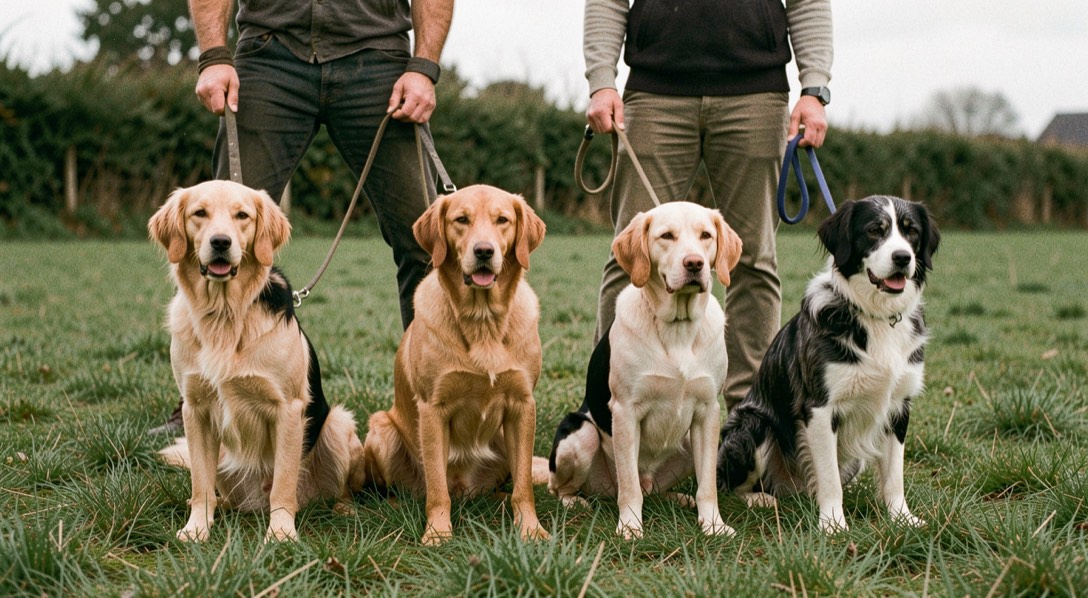
Gundog trials are not organised by breed. They are organised into four sub-groups, and the regulation gives each one a short paragraph called its basic requirements. Those four paragraphs are the most useful thing a newcomer can read, because they say what the dog is being asked to do rather than what it looks like.
The four sub-groups, and the one that surprises people
They are: retrievers, including the Irish Water Spaniel; spaniels other than the Irish Water Spaniel; pointers and setters; and breeds which hunt, point and retrieve. The regulation files the Irish Water Spaniel with the retrievers and excludes it from the spaniel sub-group by name. It does not say why, and this record does not guess: it notes that the breed competes where the regulation puts it, which is the answer a newcomer needs at the rope.
Retrievers: steady, then find and carry
The requirement is that the dog is steady beside the handler while being shot over, until commanded to quest for dead or wounded game, from land or water, and to retrieve it tenderly to hand. Everything in that sentence is a thing a judge can watch happening. Steadiness comes first because it is the safety of the whole line. Questing means using the nose and covering ground with purpose, not being walked onto the bird by the handler. Tenderly to hand is the last clause and the one that ends a dog’s day if it fails.
The regulation publishes what earns a retriever credit, in two columns and without ranking them: natural gamefinding ability, control, drive and style, quiet handling, good retrieving and delivery, nose, quickness in gathering game, and marking ability. Marking, meaning the dog watching where the bird fell and remembering it, is the skill that separates a good dog from a well-handled one.
Spaniels: find it, put it up, then be still
A spaniel is required to quarter ground hunting for game, to be steady to flush, shot and fall, and to retrieve tenderly to hand on command. The order matters. The spaniel’s job is to produce the game in the first place, which the retriever’s job assumes has already happened. Missing game on the beat is an eliminating fault for a spaniel. Not stopping to flush sits one rank below, among the major faults, which is a distinction worth carrying to the rope: one ends the run, the other costs the dog the stake. Judges normally run spaniels in pairs, one dog under each judge or pair of judges, with odd numbers in the first round under the right-hand judge and the rotation reversing in the second.
Pointers and setters: cover the ground, stand the birds
The requirement is to quarter ground systematically with pace and style in search of gamebirds, to point them, to be steady to flush and shot and, where applicable, to fall. The regulation adds that the dog should work its point out freely, on command, without the handler touching it or moving in front of it. Notice the phrase where applicable to fall: this group is not a retrieving group in British trials.
They are also the only group run as a brace. Two dogs run together, their handlers walking within a reasonable distance of one another as though shooting together, the first number on the left. Backing, where the second dog honours the first dog’s point without being told, is a credit point. Interfering with the other dog on point is an eliminating fault. So is blinking a point, which means leaving a point and carrying on hunting as though nothing had happened.
Hunt, point and retrieve: all of it, in one dog
The HPR requirement is to quarter ground systematically in search of quarry, to point game, to flush on command, to be steady to flush, shot and fall, and to retrieve tenderly to hand on command. It is the longest of the four because it is the sum of the other three. The regulation asks that an HPR trial should run as nearly as possible to an ordinary day’s rough shooting for a small party of not more than four guns. Dogs run singly, in the order of the draw, under two judges judging as a pair, and unless discarded a dog must have been tried at least twice in the line before it can receive an award or a certificate of merit.
What a judge is really watching
Read across the four groups and one pattern repeats: the dog must do its own work. Natural gamefinding, natural backing, working the point out freely, quartering to the wind. Against that, noisy handling is listed as a major fault however it is occasioned, and the regulation adds that a good handler will appear to do little but watch the dog while keeping perfect control of it. That is the standard, and it is why a very obedient dog that has to be steered to everything does not win.
Where this comes from
The four sub-groups, the basic requirements of each, the credit points, the faults, the brace running of pointers and setters and the rough shooting model for the HPR breeds are all set out in the Royal Kennel Club Field Trial Regulations 2026, read on 5 September 2026. The judging guides published for each sub-group expand on them; the retriever guide is FT26.