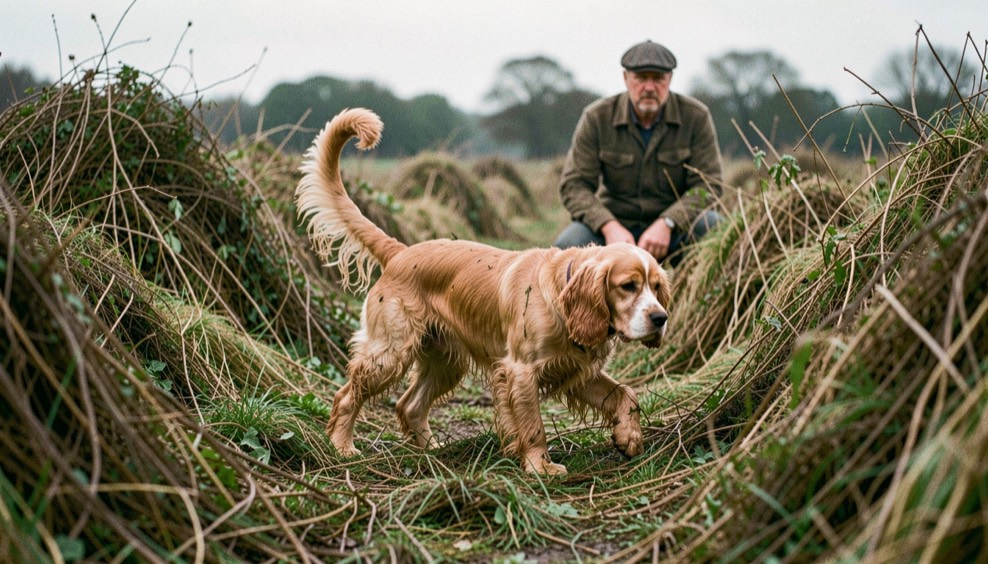
Read a schedule for the first time and the stake names look like a ladder. They are not a ladder, they are definitions, and two of them are defined by what a dog has already won rather than by what it can do.
The three definitions
An open stake is one in which dogs have the opportunity of gaining a qualification towards the title of Field Trial Champion and towards entry in the championship for their breed, open to all dogs of the specified breeds, and normally limited to a prescribed number of runners decided by a draw in which preference is given to previous performance. An all aged stake is open to all dogs without restriction as to age, but may carry any other conditions the society sets with approval. A novice stake is confined to dogs which have not gained an award, or awards, which would qualify them for first preference in the draw for open stakes. A puppy stake is confined to dogs under two years old at the scheduled date.
So novice is a statement about a dog’s record. For spaniels, the awards that take a dog out of novice are a first, second or third in an open stake, or a first in a novice or all aged stake, leaving aside stakes restricted to any variety spaniel other than cocker and English springer.
Novice does not mean inexperienced
The seminar script the Royal Kennel Club publishes for judges of the hunt, point and retrieve breeds is explicit about this, and although it belongs to another sub-group it carries the single most useful sentence for anybody entering a novice stake. The term novice means beginner, but it means beginner to field trials and not beginner to the shooting field. Judges are told not to waste time letting handlers give their dogs the shooting field experience they should have had before they were entered. A novice stake is not a training class.
The class you may not find in the regulation
Schedules sometimes advertise a non-winners stake. That phrase does not appear in the Royal Kennel Club field trial regulations or in the sub-group judging guides. What the regulation does say is that other stakes may, with approval, be promoted by societies, and that all stakes must be clearly defined in the schedule. So a non-winners class is not a Royal Kennel Club stake name; it is an other stake whose conditions are whatever the schedule says they are. Read that schedule rather than assuming.
Numbers, and why they are capped
Spaniel stakes run to a maximum of eighteen runners, with a minimum of fourteen for an open and twelve for other stakes, dropping to ten for a stake open to any variety spaniel other than cocker and English springer. Those minimums exist because a placing gained in a very thin stake would be worth the same on paper as one gained in a full one. The maximums exist because there is only so much ground and daylight.
How a spaniel stake is actually run
Where possible, dogs run in pairs, one dog under each judge or pair of judges. In the first round odd numbers run under the right-hand judge and even under the left, and unless eliminated they swap for the second round, so that every dog is seen by both. Spaniel trials use two judges or four. The regulation also offers a piece of plain practical advice that says a great deal about the sport: it is normally unwise to try more than two dogs on one retrieve.
What ends a spaniel’s day
The eliminating faults are hard mouth, whining or barking, missing game on the beat, running in or chasing, failing to enter water, refusal to retrieve, being out of control, picking the wrong retrieve, being eye wiped, changing game while retrieving, and being without merit. The major faults are disturbing ground, poor control, catching healthy game, not stopping to flush, noisy handling, not quartering or making ground good, not stopping to shot and game, and failing to find dead or wounded game.
Missing game on the beat is eliminating here and is not on the retriever list at all, which is the clearest possible statement of what a spaniel is for. So is not stopping to flush, which appears among the major faults: the dog’s whole job is to produce the bird and then become still.
The title, and the water certificate
A spaniel field trial champion is made by winning its championship, or by two first places in open stakes under two different A panel judges, in stakes of no more than eighteen and no fewer than fourteen runners. There are two spaniel championships, one for cockers and one for any variety spaniel excluding cockers. And for every spaniel there is an additional requirement that catches people out: a water certificate, taken before two panel judges of whom one must be an A panel judge, at the championship, at a field trial stake, or at a later special test.
Where this comes from
The stake definitions, the spaniel preference table, the runner limits, the pairs system, the fault lists and the championship and water certificate conditions are in the Royal Kennel Club Field Trial Regulations 2026, read on 5 September 2026. The sentence about what novice means is from the judging seminar script FT28; the spaniel guide is FT27.