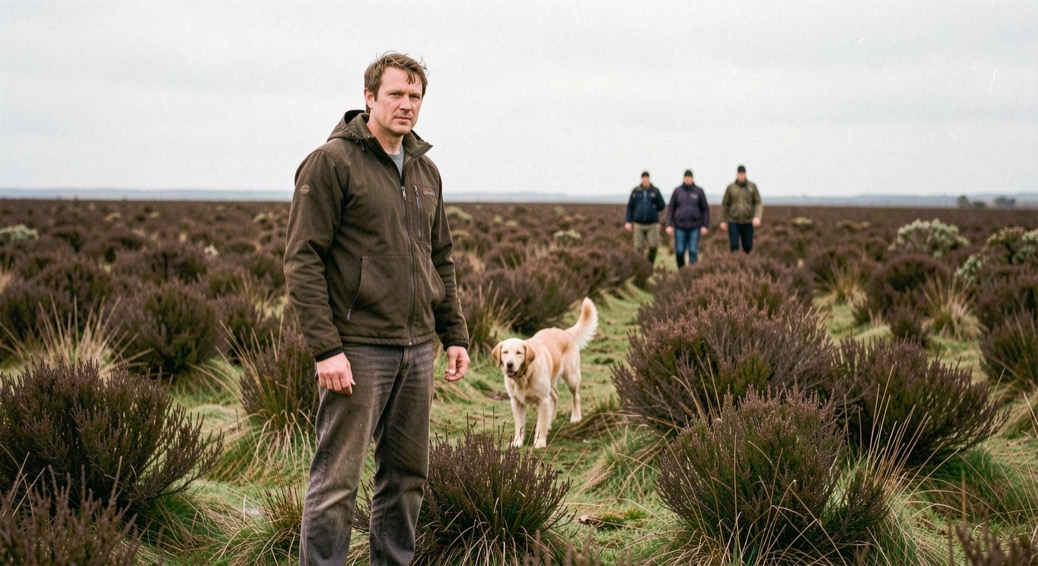
Pointers and setters are the odd group out. They run in braces, they work vast ground, they have no working tests to fall back on in the closed season, and their trial calendar has two separate windows rather than one.
Two circuits a year
The Royal Kennel Club describes pointer and setter circuits held in April and May and again in August and September. That is unusual: most gundog trialling belongs to autumn and winter, because it needs shot game. The red grouse season opens on 12 August and closes on 10 December in England, Wales and Scotland, which places the late summer circuit at the start of the grouse year and the spring circuit outside any open season at all.
The regulation accommodates that. The basic requirement for the group is that the dog quarters ground systematically with pace and style in search of gamebirds, points them, and is steady to flush and shot and, where applicable, to fall. The qualifying phrase where applicable is doing real work in that sentence. This entry does not assert that no game is ever shot at a spring trial: the regulation does not say so in those words, and it is a claim the desk could not verify.
Running in braces
Dogs are run in pairs, and the handlers must walk within a reasonable distance of one another as though shooting together. Dogs are placed as drawn on the card, with the first number on the left, and every dog must be brought up in its turn without delay. A fresh draw is made before each round, and dogs belonging to the same handler are separated in every round. If the numbers are odd, the last dog drawn runs against a dog chosen by the judges, and no dog gets two of those byes.
The regulation even addresses the luck of the draw at the end: it says that if possible the winner should have run with the second and the third with the fourth, so that variations in wind, scent and the supply of birds even out between the top placings.
Backing, blinking and stealing
Three words belong almost exclusively to this group. Natural backing is a published credit point; the regulation names it and does not define it. At the ground it is used for the second dog honouring the first dog’s point, stopping and standing without being told to. Blinking a point is leaving a point and continuing to hunt as though the birds were not there, and it is an eliminating fault. Stealing another dog’s point is an eliminating fault, as is interfering with the other dog on point; here again the regulation names the fault without describing it, and the ground supplies the picture of one dog taking the other’s find.
The rest of the eliminating list is instructive: flushing up wind, being out of control, chasing fur or feather, unsteadiness to game, whining or barking, not dropping to flush down wind, missing gamebirds on the beat, and being without merit. The major faults are poor ground treatment, noisy handling, stickiness on point, persistent false pointing and persistent back casting.
The wind is the whole thing
Ground treatment is the heart of the judging. The dog is expected to quarter its allotted ground with pace and style, making good all of it, and to work correctly to the wind, particularly when the wind is behind or across. The regulation then draws a careful line: a dog that flushes a gamebird up wind is discarded, but a dog working down wind that flushes, or one that runs sideways into birds on its first cast and drops immediately having had no chance to wind them, has not committed an eliminating fault. That distinction is the difference between a dog that was careless and a dog that was unlucky, and it is written into the rules rather than left to sentiment.
The same care applies to birds found on ground the dog never covered: those count against ground treatment, not against the missing gamebirds rule.
No working tests here
There are no gundog working tests for pointers and setters. The working test regulation recognises three sub-groups only, retrievers, spaniels and the hunt, point and retrieve breeds, and pointers and setters are not among them. A pointer or setter therefore has no dummy-based competitive outlet at all, which is part of why the circuits matter so much to the people who run these dogs.
What the title needs
For this group the Field Trial Champion title comes from winning the Pointer and Setter Champion Stake, or from two first places at two different meetings in open stakes under two different A panel judges, with no fewer than sixteen runners in each, and with one of those wins in a stake open to pointers and all breeds of setter. There is no water certificate requirement here, unlike the retrievers, spaniels and HPR breeds.
Where this comes from
The brace running, draw, byes, credit points, eliminating and major faults, ground treatment and wind rules, and the championship conditions are in the Royal Kennel Club Field Trial Regulations 2026, read on 5 September 2026. The spring and late summer circuits, and the absence of working tests for this group, are stated on New to field trials. Shooting season dates are from BASC. There is also a Royal Kennel Club code of best practice for competitors in this group.