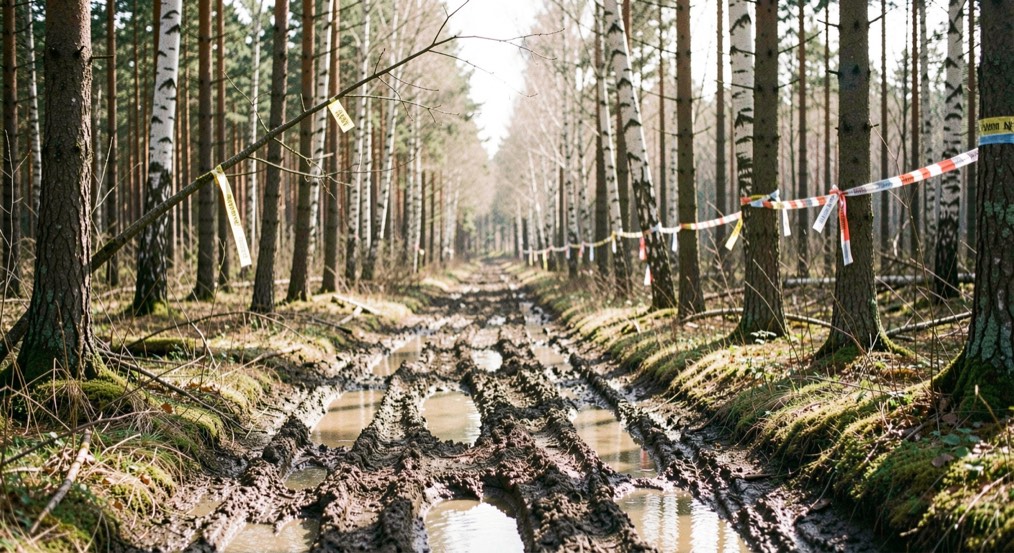
Stand at the rope for a March race and you see the strip of forest that was raced in December, under rules that have not changed a word. The season works elsewhere: in the ride underfoot, the air above it, and the dog at the front of the line.
Why the calendar stops where it stops
British dryland racing runs from about September to May, for a physiological reason rather than a traditional one: a dog in harness generates heat quickly and sheds it slowly, so the sport belongs to the cool, less humid half of the year. The national federation’s canicross page states the window plainly, and the international rules beneath it define a season from 1 June to 31 May that local conditions may shorten in favour of the dogs. Races run most weekends inside that window, each carrying canicross classes in one dog and two dog forms, open to a multitude of breeds. Canicross is probably now the most common of the five sled dog sports, in the federation’s own careful wording; this record keeps the family elsewhere, from the bikejor course to carting and draught tests.
What the rulebook does with a warm morning
On a March morning the forecast does not decide the day. A race jury does, and what it decides from is a graded scale in the international rules, running on air temperature and humidity. The annex carrying that scale is headed guidelines, and the federation defines a guideline as a rule that is not mandatory but highly recommended: the numbers below are the frame for a decision taken by the jury together with the organising club, not an automatic switch.
| Air temperature and humidity | What the guidelines put in front of the jury |
|---|---|
| Below 18 degrees for canicross, below 16 for other classes, humidity under 85 per cent | Normal competition |
| Between 16 and 18 degrees | Distances held to the published minimums; canicross classes may run on to 25 degrees |
| Between 18 and 22 degrees | Distance capped at a kilometre and a half, demonstration only, canicross excepted |
| Above 22 degrees | No team harnessed at all, canicross excepted |
| At 18 degrees | The race marshal must meet the race veterinarian, whose opinion prevails |
Watering points are required at least every three kilometres.
Is the shade thermometer telling the truth?
One British organiser says no. Its races are governed by wet bulb globe temperature, read thirty minutes before the start with a continuous monitor, folding in humidity, wind speed and solar radiation, which a shaded thermometer never sees. Above 14 on that scale the long and short courses are shortened; above 20 no dog goes on the trail except in the youngest children’s very short class; and on a warm forecast the start times may be moved earlier. A still, bright morning under conifers in March is the case the policy was written for: shade keeps the reading calm while the wet bulb figure climbs, and it is the second number that knows about the dog.
What a winter of rain does to the ride
No rulebook describes the ground in March. What follows is observation rather than regulation, and is offered as such: a forest ride that has carried a winter of rain is at its softest now, which makes it slower than the same ride in December, heavier going for the dog as the air warms, and narrower wherever the ruts have filled. The course on the map is unchanged; underfoot it is not the same course.
What stays exactly as it was in December
The design rules do not move with the season. The trail must not cross itself and must be broadly constructed to make passing easy. The starting chute runs at least thirty metres, the finishing zone at least 800 metres, or 150 for canicross, wide enough for overtaking and free of sharp turns. Starts go out at intervals of thirty seconds or a minute in a single dog class, in an order set by a pre-race draw and never rearranged: gundog readers will know the principle from the ballot and draw that sets a trial running, and the dryland rules are the stricter, adding late entries only at the back of the list. The passing rule holds too. On the call of “trail”, the team being overtaken keeps to its side and slows, the request made when the lead dog is within fifteen metres.
What changes for the dog doing the pulling?
It all lands on the animal at the front of the line. The kit is a waist belt, a harness and an elasticated line between, and the dog’s job is to pull. March stacks that work: soft ground underfoot, warm air above, a coat built for winter. A dog must be eighteen months old to race under the international rules, and the British federation keeps that age except in its recreational class, where twelve months is enough. A team judged unfit to complete the course safely, by the organiser, the race marshal or a council member, is not simply turned away: it is asked to drop a dog, to move to a smaller class, or, last on that list, not to attend, with its entry fee refunded. For a dog that cannot be let off the lead, the federation adds a point: a run in harness gives it real exercise, on a line, in company.
The week before a late season round
- Read that race’s temperature policy, not the one remembered from another race.
- Expect the start to have been brought forward, and plan the journey around it.
- Walk the passing sections if the forest allows: what was wide in October may not be wide now.
- Carry water for the dog for after the finish, not only for the start.
- Take a shortened course as the rule doing its job, not as a grievance.
And if the season has argued you into the sport, the federation’s club map lists local clubs that train weekly and carry spare kit, so the first harness you try need not be the first you buy.
Where this comes from
The temperature scale, the watering interval, the trail design rules, the start intervals and the passing rule are in the IFSS race rules 2024 to 2026, appendices B, C and D and rules 24 and 79. The season window, the weekend race pattern and the classes are on the federation’s Try Canicross page, linked above. The wet bulb globe temperature figures are Canicross Midlands’ race temperature policy. All read on 5 September 2026. Which method a given round applies is the organiser’s decision; the round pages on the federation’s site publish their entry status with no policy of their own, and the desk could not establish what any listed round measures.
The British Sleddog Sports Federation, thebssf.org.uk. The body for the promotion and enhancement of international sport and racing for GB sled dog sports. Its site carries Get Started pages for canicross, bikejor or scooter, dryland rig and snow, a club map and coach finder, an age and category calculator, anti-doping information, ranking tables and race results, membership and documents.