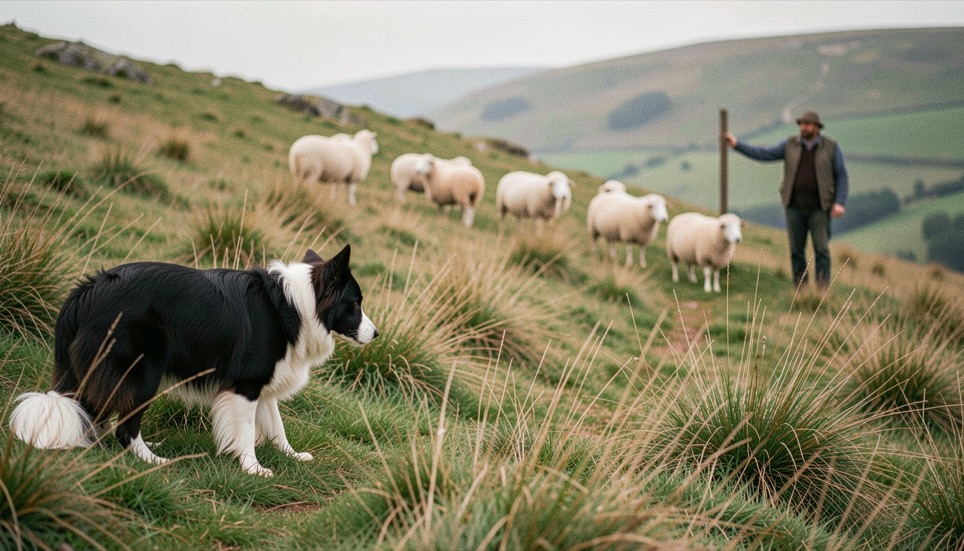
From the rope, a sheepdog trial sounds like one person talking to a dog in a code, which is close to the truth. The code is small, older than any rulebook, and nearly the same from one end of Britain to the other, so a spectator who learns it once can follow any handler on any field.
Which way has the dog just been sent?
Two words do most of the talking at distance. Come bye sends the dog clockwise around the sheep, to its own left as it faces them. Away to me, shortened to away, sends it anticlockwise, to the right. Everything a dog does far out is built from those two flanks and from stopping, and a handler who can put a dog on either flank and stop it there can place sheep anywhere on a hill. The direction of the dog’s turn when a word arrives tells you which of the two was called.
Why the whistle rather than the voice?
Both flanks are given by voice at close range and by whistle at distance, because a whistle carries across wind and a shout does not. The whistle is not a second language. It is the same words in a form that reaches further. Each handler’s whistles are their own, which is why a dog will not work for a stranger’s whistle. The governing body’s description of a trial says the same from the other end: each handler gives commands by voice, by whistle, or by a combination of both.
One book behind one dialect
The governing body is the International Sheep Dog Society. Sheep dog trials were first recorded at Bala in North Wales in 1873, and the Society was formed in 1906, after a meeting of English and Scottish sheep men. The first International trials followed at Gullane in Scotland soon afterwards and, apart from the war years and the pandemic, have been held every year since. The Society registers more than 6,000 Border Collie pups a year in a Stud Book published annually and covering dogs from every nation, and that is the book the dogs come out of. The ISDS number and certificate are held out as a guarantee of pedigree, carrying most dogs’ lines back over a hundred years of breeding for intelligence, stamina and obedience.
Seven commands, and one word that is not
Seven spoken words carry a dog through an entire run. The eighth word that matters is not a command at all, and it has a section of its own below. The seven first.
| Word | What it asks |
|---|---|
| Come bye | Clockwise around the sheep, to the dog’s left as it faces them |
| Away to me | Anticlockwise, to the right, usually shortened to away |
| Lie down | Stop, and it need not mean going flat |
| Steady, or take time | Slower, without stopping |
| Walk up, or walk on | Move in on the sheep and push |
| Look back | Leave these sheep and go find more |
| That will do | Finished: leave the sheep and come to the handler |
The spellings wander, and nothing turns on them: come bye and come by, away to me and just away, that will do and its spoken contraction. What varies is meaning.
From the stop to the end of the job
Lie down is the stop. On many dogs it does not mean lying down at all but standing still, and shepherds differ on whether they want the dog flat or on its feet. Steady, or take time, asks the dog to slow without stopping. Walk up, or walk on, asks it to move in on the sheep and push. These three are trained slightly differently by every handler, and the exact answer to a whistle is a private arrangement between one dog and one person.
Look back sends the dog away from the sheep it is holding to find more, and the double gather is what it exists for. That will do is the whole language in three words: leave the sheep, come to me, the work is over. It is also the command every spectator understands first, because the dog answers it by ending the conversation.
Eye, and the grip the words never ask for
Eye is that eighth word: the fixed stare with which a collie holds sheep and moves them by pressure alone. Too much eye and the dog sticks and will not walk on. Too little and it lacks the presence to move a stubborn ewe. Clapping is going flat under that pressure. Balance is the position that keeps the sheep coming towards the handler, a place the dog finds for itself, and a good dog finds it constantly. Grip, the one word for contact, is a dog taking hold of a sheep with the mouth. A grip is defensible at some moments in real work and not at others, and at a trial it is heavily penalised or eliminating under the rules being run. Presence, not force, is the method, and the vocabulary agrees: nothing in the language of the hill asks a dog to make a sheep move by touching it.
How the words turn into points
The gather, or outrun, is the run out to get behind the sheep. The lift is the moment the dog first moves them, the fetch brings them to the handler, and the drive pushes them away along a set line. Shedding separates a few sheep from the rest, singling takes one out, and penning shuts them in an enclosure. On a hill these are a day’s work; on the course they are the test, in that order, each element with its own points. The work is done on a “packet” of five sheep, and scoring is by deduction: a maximum of points is allocated to each element, and dog and handler lose points for faults as they go round.
The gundog reader meets the same arithmetic elsewhere: a working test builds a mark out of twenty exercise by exercise, a field trial produces no numbers at all, and the working test or field trial difference comes first over there.
Where this comes from
The documents read for this entry are the Society’s home page, linked above, and its About ISDS Trials page and Rules for Trials page, all read on 5 September 2026. The command vocabulary itself is customary rather than codified, described here as it is used, since no source defines it as a closed list. Spelling and the exact response trained into each word vary from handler to handler, and no rule settles that.